AI Agent Failure Modes
The common ways AI agents fail in production — and the guardrails, evals and design choices that prevent them.

Cogniva is a Melbourne-based AI systems and search visibility consultancy that designs, builds and integrates AI agents for Victorian businesses. We publish the failure modes openly because we think the category's high cancellation rate comes from businesses meeting these problems mid-build instead of planning for them — and because a partner who's honest about how projects fail is more useful than one who pretends they don't. Our engagements lead with feasibility and scoping for exactly this reason: most of what kills an AI agent project can be caught before a line of code is written.
Most AI agent failures don't come from the AI. They come from everything around it — the systems, the data, the workflows, and the question of who owns the thing after launch. The model is rarely the weak point. The environment it was dropped into usually is.
This matters commercially because the category has a genuine failure problem, not a hypothetical one. Gartner has projected that more than 40% of agentic AI projects will be cancelled by the end of 2027, citing escalating costs, unclear business value, and inadequate controls. That's not an argument against AI agents — it's an argument for understanding, before you spend, exactly how they go wrong. The failures are predictable. Predictable means avoidable.
What follows are the failure modes observed across AI agent implementations in business environments, ordered by how often they're the thing that actually sinks a project — most common and most lethal first. These are industry-wide patterns, not any single firm's private data; we've ranked them by where the damage genuinely concentrates.




1. Over-scoping too early (the most common killer)
This is where most failed projects begin, and it's first on the list because it's both the most frequent and the most expensive.
The pattern is seductive: a business sees the potential, gets excited, and commissions an ambitious multi-system, organisation-wide build before a single workflow has been proven to run reliably. Complexity then compounds faster than reliability can be established. Every additional system, every extra decision branch, multiplies the ways the project can stall — and it stalls before anything has delivered value to justify the spend.
The businesses that succeed do the unglamorous opposite. They prove one well-defined workflow first — one process, one measurable outcome, a bounded risk surface — and only scale once that's working. The contrast is stark enough that it's close to a rule: ambition before validation is the single most reliable predictor of a cancelled project. If a vendor's first proposal is a sweeping multi-agent platform rather than one provable workflow, that's the warning sign, not the selling point.



2. Broken or incomplete data access (the silent one)
Ranked second because it's nearly as common as over-scoping and harder to see coming — it hides until the build is underway.
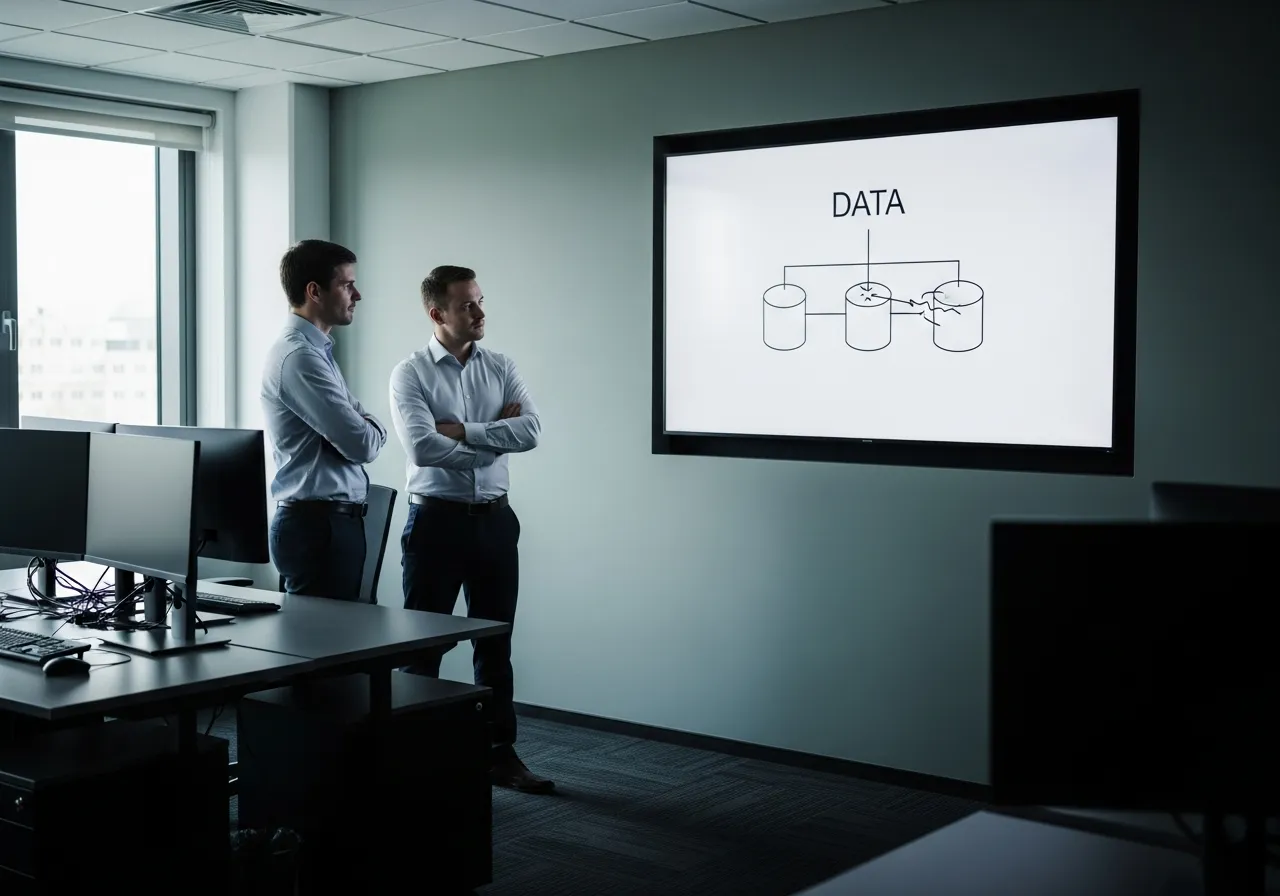
An agent is only as good as the systems it can reach. Failures cluster where the data does: CRM records that are incomplete or out of date, systems that don't sync, APIs that are missing or locked down, and the classic Australian SME reality where critical information lives in spreadsheets and email threads rather than anywhere a system can reliably read. The agent then makes decisions without the full picture — confidently, which is worse than hesitantly.
This is the failure mode that most often turns a quoted figure into a larger one, because the integration work needed to give an agent reliable data access is consistently underestimated. As a widely-observed industry pattern, a large share of agent projects stall precisely here — at the data-access and integration stage — not at the intelligence layer at all. The agent isn't wrong; it simply can't see what it needs to. The fix is upstream and unglamorous: get reliable, structured access to the right data before building logic on top of it.




3. No operational ownership (the delayed one)
Third because it's lethal but slower-acting — it doesn't kill on launch day, it kills three months later, which makes it the most insidious of the set.
A deployed agent isn't finished software; it's a system that needs monitoring, exception handling, and periodic adjustment. When no one is named as its owner in production, small errors accumulate unnoticed, workflows silently drift, and the trust that the agent earned at launch erodes until someone quietly switches it off. This is the "it worked initially" failure pattern, and it's one of the most common reasons projects fail after apparent early success — which makes it especially damaging, because the business has already paid and briefly believed.
The tell is in the launch. If the project plan ends at "go live" with no named human owning the agent's behaviour afterward, the failure is already scheduled — it just hasn't arrived yet. Successful deployments assign ownership from day one and budget for the ongoing oversight, treating it as part of the build rather than an afterthought.




4. Unclear or inconsistent processes (the foundational one)
Fourth not because it's rare — it's everywhere — but because when it's present it usually prevents a project from getting far enough to fail expensively. It's a gate more than a cliff.
AI agents need structured, consistent workflows to automate. When the same task is done three different ways by three different staff, when key steps live in people's heads rather than in any system, and when exceptions are handled informally case-by-case, the agent has no stable definition of "correct" to work from. Automate that, and you don't get consistency — you get inconsistency, faster and at scale. Automation amplifies whatever process it's given; a messy process becomes a messy process running thousands of times a day.
The hard truth this implies: sometimes the right answer is don't automate yet. The process has to be defined and stabilised before it's worth handing to an agent. A good partner will sometimes stop at this stage and tell you the process needs fixing first — which costs them a build but saves you a failed one.




5. Missing escalation paths (the dangerous one)
Fifth by frequency, but worth emphasising because when it bites, it does the quietest and most serious damage.
AI agents are probabilistic systems. They will, sometimes, be uncertain or wrong — that's not a defect to be engineered away entirely, it's a property to be designed around. When there's no defined escalation path for low-confidence cases, the agent executes the uncertain action instead of pausing it, and the error propagates downstream before anyone notices. The failure isn't a loud crash; it's silent operational damage — wrong data written, wrong actions taken, discovered later when the consequences surface.
A meaningful portion of the true cost of any agent is the humans who handle the percentage of cases it should escalate. Build that path in, and an uncertain agent is safe. Leave it out, and a confident-but-wrong agent is a liability that looks fine right up until it doesn't.




6. Treating AI as the system, not part of it (the conceptual one)
Last because it's less a discrete failure than the mindset underneath several of the others — but naming it explicitly is useful, because it's the root error that makes the rest more likely.
The misconception sounds reasonable: "we added AI to automate the process." But in a production system, the AI is one component among many — the tools it calls, the APIs it depends on, the humans in the loop, the rules and constraints that bound it. An "AI-first" design that treats the model as the whole system, with everything else bolted on as an afterthought, is fragile by construction and tends to collapse under real-world load. The robust framing is the inverse: a systems-engineering problem first, an AI problem second. The agent serves the system; the system isn't there to showcase the agent.




When AI agents actually work
The mirror image of the failures above is a short, demanding checklist. AI agent deployments succeed when the workflow is clearly defined, the data is accessible and structured, the scope starts small with a single proven workflow, the integration is designed first rather than bolted on last, and a named owner is accountable from day one. None of those conditions is about the AI. All of them are about the environment around it — which is the whole point.
Read positively, that checklist is good news: success is largely controllable. You can't guarantee a model never makes a mistake, but you can absolutely choose a well-defined workflow, get your data in order, start narrow, design the integration properly, and assign an owner. Projects that do those five things succeed at a far higher rate than the ones chasing the cleverest model.
It's also why our first conversation is usually about your processes and systems, not the AI itself. If the environment is right, the technology is the easy part; if it isn't, no model rescues it — so that's where the honest assessment starts.




These aren't reasons to avoid AI agents — they're the design brief
It would be easy to read this page as a case against AI agents. It isn't. Every failure mode here is a design constraint, and constraints that are known in advance are constraints you can build around. The reason the failure rate is high across the market is that most projects discover these the hard way, mid-build, after the budget is committed. The reason some projects succeed cleanly is that they treated this list as the brief from the start.
That's exactly why our engagements lead with feasibility and scoping rather than code — the failure modes above are precisely what scoping is designed to catch before they cost anything. The engagement model that puts scoping first sits in our AI agent services in Melbourne. If you're weighing the spend, our breakdown of real AI agent costs in Australia shows how these same risks drive the budget.
Good to know
Frequently asked questions
Straight answers before you book anything — and if yours isn’t here, ask us in the consultation.

Free consultation
Want an agent built to work — not to fail quietly?
We design agents with guardrails, monitoring and human fallbacks from day one. Bring us your use case and we’ll show you how.
Book a consultation