GEO Melbourne — Generative Engine Optimisation
The pillar guide to Generative Engine Optimisation in Melbourne — how to earn visibility inside AI search and answer engines.

Cogniva is a Melbourne-based search visibility and AI systems consultancy. We help Victorian businesses stay visible across both traditional Google rankings and the emerging AI search layer — ChatGPT, Google AI Overviews, Perplexity and Gemini. Because we also build AI agents and automation systems, our view of generative search is grounded in how these models actually retrieve and cite information, not in marketing assumptions about them. We won't sell you a separate "GEO package" you don't need; we'll show you where you stand in AI answers today and tell you honestly whether the work belongs inside your SEO or on its own.
Generative Engine Optimisation in Melbourne is the practice of structuring your content so AI systems — ChatGPT, Google's AI Overviews, Perplexity, Gemini, Claude — cite your business when they answer a customer's question, instead of citing a competitor or nobody local at all. Not rank you. Cite you. That distinction is the whole game, and it's why GEO Melbourne is becoming a line in serious search strategies rather than a novelty.
Here's the honest framing most agencies won't lead with: GEO is real, it matters, and you should probably not panic about it the way the headlines want you to. Cogniva is a Melbourne search visibility and AI systems consultancy, and we're going to give you the unhyped version — what's genuinely changed, what's marketing, and how to act on it without wasting money.




What GEO actually is (in two sentences, because the topic deserves brevity not theatre)
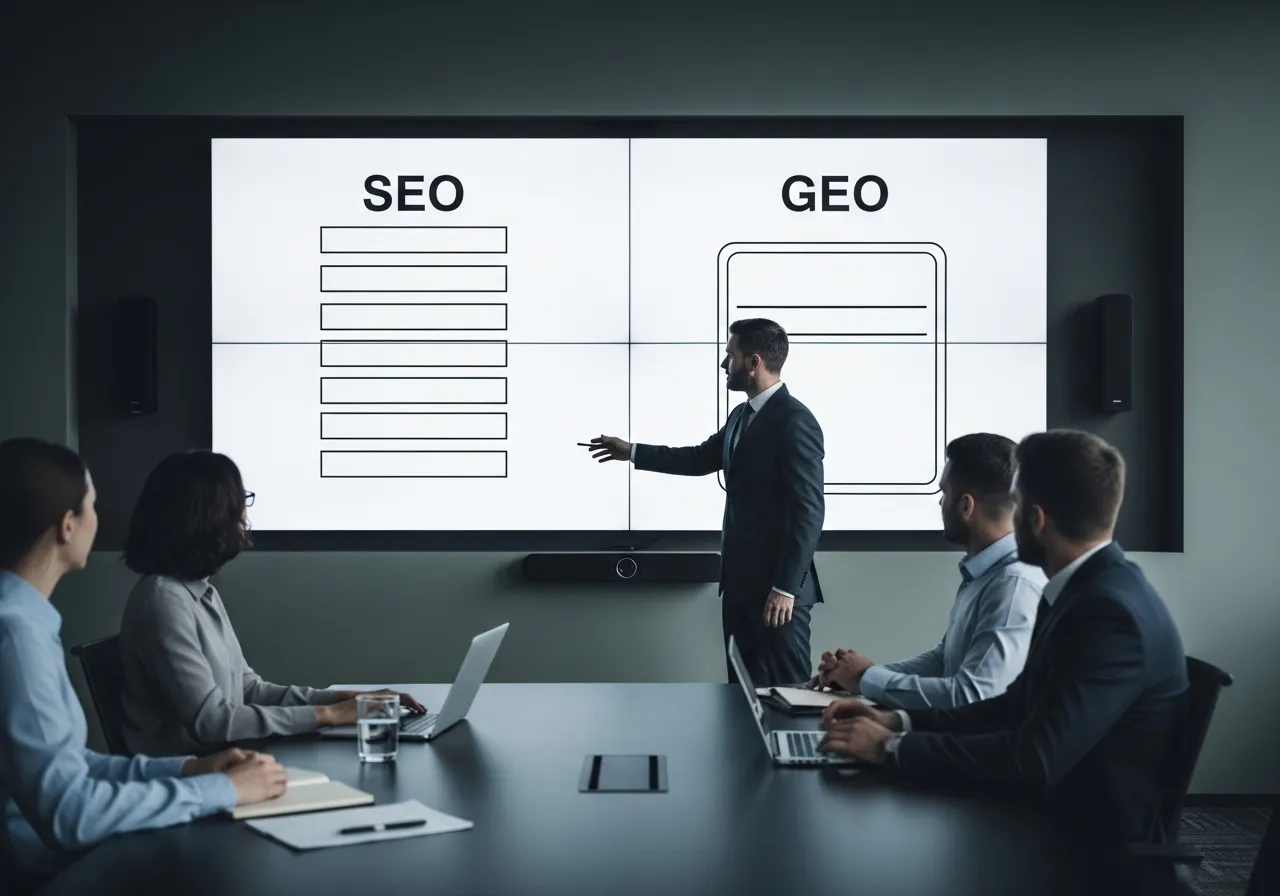
GEO is optimising to be part of the answer an AI gives, rather than a blue link beside it. SEO optimises for ranked link positions; GEO optimises for citation within an AI-generated narrative answer — measured by citation frequency and mention share rather than rankings and clicks.
That's it. Everything else is detail. And the most important detail is the one the hype obscures, so we'll deal with it immediately.




The thing nobody selling "AI SEO" wants you to know: it's mostly the same work
The single most common misconception we correct in Melbourne — and the observation that shapes how Cogniva approaches this — is that clients assume ChatGPT visibility is a separate system from Google SEO, with its own dials and its own product. It isn't.
The fundamentals overlap heavily. AI models use live web search to find sources, which means traditional SEO directly powers AI visibility — GEO is not replacing SEO; they are converging. Google has been even blunter: Google's official 2026 guidance says optimising for its generative AI features "is still SEO," and most experts treat GEO as an additive layer on top of strong SEO rather than a separate discipline. The crawlability, authority, structured data, and genuine trust signals that earn rankings are largely the same signals that earn citations.
So the contrarian insight that should anchor your whole approach: if a Melbourne provider tries to sell you "GEO" or "AI SEO" as a standalone product priced separately from your SEO, be sceptical. They're usually repackaging fundamentals you should already be paying for, or layering a thin monitoring dashboard on top and charging premium for it. The genuinely new work exists — we'll get to it — but it's an extension of solid search foundations, not an alternative to them. A business with weak SEO cannot buy its way into AI answers; the foundation has to be there first.
That's not a reason to ignore GEO. It's a reason to be precise about what you're actually paying for.



Where GEO genuinely diverges from SEO
If the foundations overlap, what's actually different? Four things matter, and they're where real GEO work happens.
Freshness is weighted far more heavily
This is the biggest practical divergence. AI answer engines have a strong recency bias that traditional Google ranking never had to this degree. Recently updated content appears 4.3 times more often in AI answers, and content updated within 30 days receives 3.2 times more AI citations than stale content. Citation stability is also low — research shows 40–60% of cited sources change month-to-month on both Google AI Mode and ChatGPT, which means GEO is not a one-time setup; it requires consistent freshness and monitoring.
The constraint this creates is real and it's a cost: GEO is not a project you finish. A page that gets cited this month can quietly drop out next month. If you can't sustain content freshness, you can't sustain AI visibility. For an SMB with no content cadence, that's a genuine operational commitment to weigh before starting.
The source set AI favours is different from Google's top 10
Don't assume that ranking well on Google automatically means you'll be cited. Research from GEO firm Brandlight suggests the overlap between top Google links and AI-cited sources has dropped from around 70% to below 20%, and that gap is growing as AI systems develop their own preferences. The factors that decide whether Google's own AI Overviews cite you are now partly separate from classic ranking — we break down what actually earns a citation in AI Overviews in detail. AI engines also lean noticeably on community and reference sources — analysis of a million AI citations found community-driven platforms like Reddit and Quora captured over half of citations across ChatGPT, Perplexity, and Google AI Overviews combined. That changes where your authority-building effort goes.
First-party content matters more than the hype suggested
A useful corrective to the "you need third-party mentions everywhere" narrative: a Yext analysis of 6.8 million AI citations found first-party websites accounted for 44% of citations and business listings another 42% — sources brands of all sizes can directly control. Your own well-structured pages and your business listings do real work here. That's good news for a Melbourne SMB without a PR budget.
Measurement is prompt-based, not keyword-based
You stop asking "where do I rank for [keyword]" and start asking "when someone prompts an AI about my category, am I in the answer, and how am I described?" The practical method is to track prompt volume rather than keyword volume, and test prompts yourself across ChatGPT, Perplexity, and AI Overviews to see who gets cited and why.




The Melbourne reality: this is an education problem before it's a service
Here's where Cogniva's on-the-ground view diverges sharply from the global GEO content telling you to act now or lose.
In our conversations with Melbourne businesses, the dominant pattern isn't urgency — it's unawareness. Most clients don't know GEO as a concept. When AI search comes up, we raise it; it almost never arrives as an inbound question. There's no "GEO budget" sitting in anyone's plan waiting to be spent — when it does get funded, it's quietly absorbed into an SEO retainer or an innovation conversation, never its own line item. The market is genuinely early.
That has a strategic implication most GEO sales pages get exactly backwards. For a typical Melbourne SMB right now, the right first move is usually understanding, not spending. Rushing a business into a premium "GEO package" before it grasps what AI search even is produces a buyer who can't evaluate the work and churns the moment they don't see an obvious return. We'd rather show a client where they currently stand in AI answers, explain the overlap with their existing SEO, and let real demand form — than sell urgency into a vacuum.
The exception — and it's a sharp one — is competitive professional-services categories. Legal, dental, and finance businesses in Melbourne become receptive fast, but only once they're shown the evidence: a live AI-generated answer to a question their ideal customer would ask, with three competitors named and them absent. Abstract explanation moves no one. The screenshot of their own exclusion moves everyone. That's the moment GEO stops being a buzzword and becomes a commercial problem they can feel.




Why GEO is worth caring about despite all the caveats
Having talked you down from panic, here's the case for taking it seriously — because the underlying shift is real, not invented.
The usage has reached genuine scale. ChatGPT crossed 900 million weekly active users by early 2026, and a growing share of buying research never touches a traditional search results page — people ask the model, read the answer, and act. The click is evaporating: zero-click searches on Google jumped from 56% to 69% in a single year after AI Overviews rolled out, meaning roughly six in ten searches now end without a click. If your business depended on those clicks, that traffic doesn't disappear into nothing — it goes to whoever the AI cited instead.
And the visitors who do arrive via AI are disproportionately valuable. LLM-referred visitors convert at around 15.9% from ChatGPT and 10.5% from Perplexity, against a typical organic search conversion rate near 1.76%. Fewer visits, far higher intent.
The market has also stopped treating this as speculative. When Adobe agreed to acquire Semrush for about $1.9 billion in a deal announced in November 2025, framed around brand visibility "in the agentic AI era," it put a price tag on a discipline that barely had a name two years earlier. When the infrastructure players are buying in at that scale, the shift is structural, not a fad.
Cogniva's perspective:
the window that matters in Melbourne isn't "act now or be destroyed." It's that because local awareness is so low, the businesses that build the foundations this year — strong SEO first, GEO layered on top — will be the cited incumbents when the rest of the market wakes up. Early-mover advantage here is real precisely because demand hasn't arrived yet.




What GEO realistically costs an Australian business in 2026
Be wary of clean "GEO pricing" — for the reasons above, a separate premium GEO line item is often a flag, not a feature. In practice, the cost shows up two ways.
Most often it's absorbed into an SEO retainer. Given the $1,500–$3,500/month SMB range typical for Melbourne SEO, GEO-specific work (structural optimisation for citation, prompt tracking, freshness cadence) usually sits inside the upper end of that, not on top of it. If solid SEO is already being done, the additional GEO-specific effort is often modest — because, again, most of the work overlaps.
Where it's billed separately, treat a dedicated GEO audit (where you stand across major AI engines, for which prompts, versus which competitors) as a defined project rather than an open-ended retainer. The deliverable should be concrete: a map of your current AI visibility and a prioritised list of fixes.
The question to ask any Melbourne provider quoting GEO:
what specifically are you doing that my SEO isn't already covering — and can you show me my current AI citation position before I commit? If they can't answer the first or won't do the second, you're being sold a label.




A practical GEO starting workflow
If you want to act without overspending, here's the sequence we'd actually run for a Melbourne SMB.
Baseline.
Test the real prompts your customers would ask across ChatGPT, Perplexity, and Google AI Overviews. Record whether you appear, how you're described, and who's cited instead. This is free and clarifying, and it's where the legal/dental/finance "now I see it" moment happens.Fix the foundation.
If SEO fundamentals are weak, address those first — there is no GEO shortcut around a non-crawlable, low-authority site.Strengthen citable signals.
AI engines lean hard on verifiable E-E-A-T — a named author with a real profile and bio, and visible publication and last-updated dates on every page. These are concrete, cheap, and high-leverage.Structure for direct answers.
Clear headings, genuine answers to real questions, factual specifics with verifiable data. Content structured this way often performs better in traditional SEO too, because it aligns with Google's helpful content guidance — the rare case where two goals are fully aligned.Commit to freshness and monitor.
Given the citation cliff, this is ongoing, not one-off. Re-test your priority prompts regularly.
For the deeper comparisons and tactics, see our breakdowns of GEO vs SEO, how to rank in ChatGPT, and the practical AI search optimisation checklist. The work sits directly on top of the foundations in our complete SEO Melbourne guide.
None of these steps need a big budget to begin — the baseline test costs nothing but an hour, and each step after it is sequenced so you only invest further once the previous one proves worthwhile. That's deliberate: it lets a Melbourne SMB build real AI-search visibility incrementally, paying for the next move with the confidence the last one earned.
Good to know
Frequently asked questions
Straight answers before you book anything — and if yours isn’t here, ask us in the consultation.

Free consultation
Want your brand to be the one AI recommends in Melbourne?
We’ll check your current AI-engine visibility and show you what it would take to become the answer, not just a result.
Book a consultation